
Hanoi | APEC Workshop on Promoting the Application of Artificial Intelligence for the Future Energy and Sustainable Development, 16-17 July 2026
About the event
VinUni Provost, Professor Tan Yap-Peng spoke at the APEC Workshop on Promoting the Application of Artificial Intelligence for the Future Energy and Sustainable Development (EWG_103_2025A), held in Hanoi on 16 to 17 July, 2026. The workshop was organized by the Multilateral Trade Policy Department, Ministry of Industry and Trade (MOIT), Vietnam, under the APEC Energy Working Group’s 2026 program on AI and energy. It brought together policymakers, financiers, and researchers from across the Asia-Pacific to discuss policy, investment, and public-private partnerships for AI in energy, setting the stage for a deeper look at how countries can move AI-enabled clean energy projects from pilot to national scale.
A seat at the table
The case study on the table came from Singapore. Represented by Provost Tan, six-year-old VinUni was invited into a policy conversation usually led by national energy agencies, multilateral banks, and long-established research institutes. For VinUni, the invitation is one more sign of a broader trend. The university’s research centers and its leadership’s international networks are opening doors to policy discussions across the region.
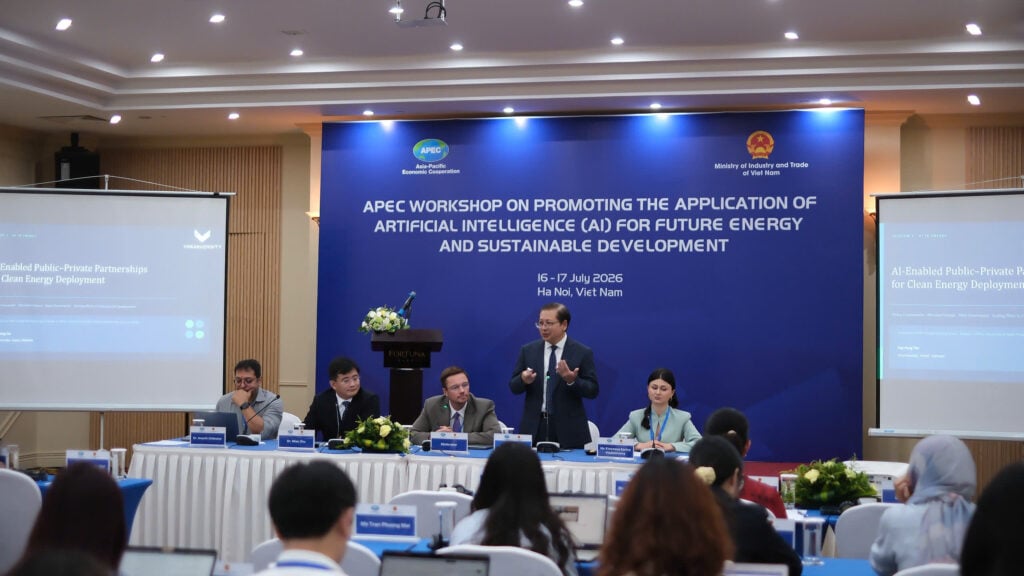
VinUni Provost Tan Yap Peng presenting in APEC Energy Working Group.
Why this case study, and why VinUni
Professor Tan’s choice of Singapore’s SolarNova program was not random. Before joining VinUniversity as Provost, he spent over two decades at Nanyang Technological University. His position put him inside the research and policy ecosystem, spanning NUS, NTU, EDB, and A*STAR, that helped build SolarNova’s data and financing model. His talk was less a borrowed case study than an insider’s account. He offered it as a model that other APEC economies, including Vietnam, could adapt as they build their AI-energy transitions.
This matters for Vietnam directly. The country’s energy transition is guided by Power Development Plan VIII and a net zero target for 2050. It faces a version of the same gap Professor Tan described. Grid infrastructure and renewable capacity are expanding. But the data governance, financing structures, and workforce readiness needed for AI-enabled optimization are still catching up. A Vietnamese university with direct access to Singapore’s playbook, and a seat at APEC’s table, VinUni has something distinctive to offer. It can act as a bridge between a proven model and a market still building its own version of it.
The Triple Helix, closer to home
Professor Tan closed his talk on Singapore’s “triple helix” model. Government acts as anchor investor. Universities serve as the knowledge engine and talent pipeline. Industry deploys at commercial scale. VinUni is already trying to build a version of this in Vietnam. Three research centers anchor the effort: the Center for Environmental Intelligence, the Center for AI Research, and the Green-X Center.
In Singapore, the “academia” node runs through NUS, NTU, SMU, and SUTD, feeding a S$37 billion Research, Innovation and Enterprise cycle. VinUni’s version is smaller and newer. But this APEC appearance suggests the university wants to be recognized as that node in Vietnam. It wants to be the place where AI-energy research, talent, and industry translation come together.
This fits a wider pattern. VinUni has been building a research profile in AI, energy, and environment. It has done so through its research centers, and through appearances like this APEC session. It has also engaged in forums such as the Vietnam-Singapore Technology Connectivity Forum, where Vietnam’s Minister of Science and Technology raised similar triple-helix thinking. The argument taking shape is simple: Vietnam needs an academic anchor for AI-energy policy, much like Singapore has one in its universities. Presenting Singapore’s model at APEC is, in part, a pitch for VinUni’s role in Vietnam’s version of that model.
What this signals going forward
VinUni is still a young institution, building its research identity. Having its Provost invited to brief an APEC policy session, rather than only publish academic work, is a real marker of institutional traction. It suggests regional bodies see VinUni’s leadership as more than technical expertise in engineering or computer science. They also see it as a source of policy-relevant thinking on how AI, finance, and governance fit together in energy.
That kind of positioning can lead to closer ties with APEC economies working through similar transitions. It can support research and PPP partnerships modeled on the government, university, and industry structure Professor Tan described. And it strengthens the case for VinUni’s centers as the applied-research partner Vietnamese agencies and companies turn to, as the country builds its AI-energy policy stack.
The real measure of this appearance is not only what APEC took from Singapore’s SolarNova story. It is what it signals about where VinUni wants to sit in Vietnam’s energy transition: not as a bystander adapting policy from elsewhere, but as the academic partner helping to write it.